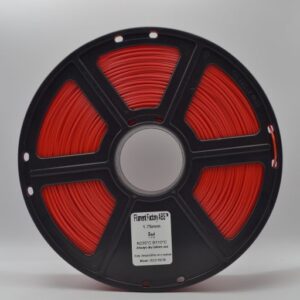
ABS Filament: Mastering High-Temperature Industrial Printing
In the commercial additive manufacturing sector, ABS (Acrylonitrile Butadiene Styrene) remains a legendary workhorse. While newer biopolymers like PLA dominate the hobbyist market due to their ease of use, industrial engineers continuously turn to ABS for functional prototypes, automotive components, and rugged end-use enclosures.
ABS offers exceptional impact resistance, high structural stability, and a heat deflection temperature that comfortably outclasses standard filaments. However, unlocking these properties requires a deep understanding of thermodynamics. ABS is notoriously sensitive to environmental conditions during printing.
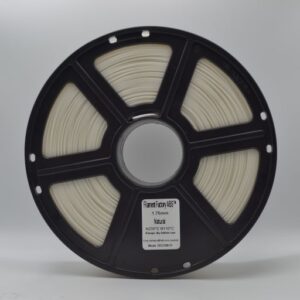
At The Filament Factory, we manufacture high-tolerance, industrial-grade ABS designed for consistent extrusion. Here is the engineering blueprint to mastering high-temperature printing with ABS and eliminating warping, delamination, and structural failure.
The Molecular Dynamics of ABS: Why Temperature Control is Non-Negotiable
To print ABS successfully, you must manage its high coefficient of thermal expansion. As molten ABS cools from its extrusion temperature down to room temperature, it undergoes significant volumetric shrinkage (up to 2%). If this cooling process occurs too quickly or unevenly, internal stresses build up within the part, causing the layers to pull apart and lift off the print bed.
[ Uneven/Rapid Cooling ] ➔ High Thermal Stress ➔ Layer Delamination & Warping
[ Actively Heated Chamber ] ➔ Uniform Thermal Gradient ➔ Perfect Layer Adhesion
Mastering ABS requires establishing a strict, controlled thermal zone across three distinct areas of your hardware setup:
1. The Hotend: Breaking the Thermal Barrier
ABS requires sustained high temperatures to achieve a complete molecular bond between layers.
- The Blueprint: Set your extrusion temperature between 230°C and $270°C, depending on your volumetric flow rate. A high-quality all-metal hotend is essential here; standard PTFE-lined hotends will degrade and release toxic fumes at these temperatures.
2. The Build Plate: Fighting Bed Adhesion Failures
Because the first layer anchors the entire print against shrinking forces, bed adhesion must be absolute.
- The Blueprint: Maintain a constant bed temperature between 100°C and 110°C. For optimal results, utilize a textured PEI spring steel sheet or apply an ABS slurry (ABS scraps dissolved in acetone) to a glass bed or utilize a specialised bed adhesive
3. The Chamber: Eliminating the Draft
An open-frame printer is the single biggest cause of failed ABS prints. Even a minor draft of cool ambient air moving across the build chamber will cause immediate part warping and layer splitting.
- The Blueprint: An enclosed printing chamber is mandatory. For large-format or high-density industrial parts, an actively heated chamber maintained at 40°C to 70°C is highly recommended. This slows down the cooling curve of the polymer, allowing the material to solidify uniformly without built-in stress.
Post-Processing Power: The Acetone Advantage
One of the most powerful reasons industrial designers choose ABS over other plastics is its reaction to solvents. ABS is completely soluble in acetone. This chemical trait unlocks advanced post-processing capabilities that are impossible with materials like PLA or PETG:
- Acetone Vapor Smoothing: Exposing a finished ABS print to controlled acetone vapor partially dissolves the outer shell, smoothing out visible layer lines entirely. This transforms raw 3D prints into injection-molded quality components with a glossy, airtight finish.
- Chemical Welding: You can permanently fuse multiple ABS parts together by applying liquid acetone to the mating surfaces. The plastic momentarily melts and fuses, creating a single, contiguous component with zero structural loss at the seam.
Critical Operational Settings for ABS Success
| Parameter | Optimized Value | Industrial Purpose |
| Nozzle Temperature | 235°C – 275°C | Ensures maximum interlayer tensile strength. |
| Bed Temperature | 100°C-110°C | Prevents thermal contraction at the base of the part. |
| Part Cooling Fan | 0% – 10% Max | Minimizes internal stress; high fan speeds destroy ABS layers. |
| Enclosure Temp | 40°C – 70°C (Passive or Active) | Maintains a uniform thermal gradient across the geometry. |
By treating ABS with the thermal discipline it demands, your workshop can reliably produce rugged, chemically resistant, and mechanically sound parts ready for real-world deployment.
Bring heavy-duty engineering properties to your production line. Secure a consistent, factory-direct supply of dimensionally stable, industrial-grade ABS filament.
View our complete material catalogue and colour profiles online at www.filamentfactory.co.za or contact our polymer distribution team for high-volume commercial pricing.